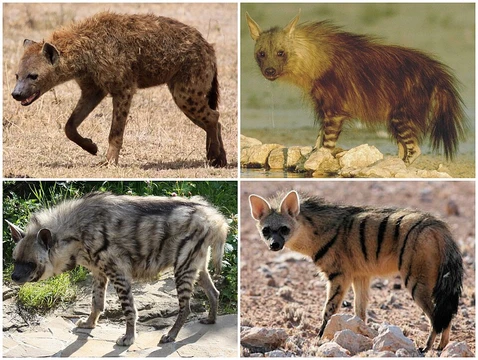
Side-striped jackal
A medium-sized canine native to Central and Southern Africa.

The side-striped jackal (Lupulella adusta or Schaeffia adusta) is a canine native to Central and Southern Africa. It has a much wider distribution than the better-known black-backed jackal, though large parts of its range lack population data. Its taxonomy has been debated, with proposals to place it in the distinct genus Lupulella or Schaeffia based on DNA evidence and dental differences.
- Scientific name
- Lupulella adusta or Schaeffia adusta
- Native region
- Central and Southern Africa
- Body mass
- 6.5 to 14 kg
- Head-and-body length
- 69 to 81 cm
- Tail length
- 30 to 41 cm
- Shoulder height
- 35 to 50 cm
- Gestation period
- 57 to 70 days
Lore & Background
Fossil remains date to the Pliocene era, and mitochondrial DNA analysis places it and the black-backed jackal as the most basal members of the wolf-like canid clade, suggesting an African origin. Studies also note dental differences supporting the Schaeffia classification, and the early Pliocene African Eucyon khoikhoi is considered a basal member of this African group.
Reader's Guide
The side-striped jackal is significant as a highly adaptable omnivore that plays a role in its ecosystems across Central and Southern Africa. Its dietary habits shift seasonally, from invertebrates in the wet season to small mammals like springhares in the dry months, and it frequently scavenges from campsites and larger predators' kills. It is less predatory than other jackals, rarely targeting prey larger than neonatal antelopes. Socially, it lives solitarily or in family groups of up to seven, with monogamous breeding pairs that mate for life. Its taxonomy remains debated, with proposals to reclassify it into the genus Lupulella or Schaeffia based on genetic and morphological evidence. The species has seven recognized subspecies, and its population status is unknown across large parts of its range, highlighting a need for further research.
Did You Know?
- The side-striped jackal has a much wider distribution than the black-backed jackal, but large parts of its range lack population data.
- Fossil remains of the side-striped jackal date to the Pliocene era.
- A side-striped jackal from Angola was found to host the intestinal acanthocephalan worm Pachysentis angolensis.
- The side-striped jackal is among the few mammal species that mate for life, forming monogamous pairs.
Frequently Asked Questions
Who is Side-striped jackal?
The side-striped jackal (Lupulella adusta, sometimes placed in the genus Schaeffia) is a medium-sized wild dog native to Central and Southern Africa. It is one of the most widely distributed canines on the continent, occupying a broader range than the more familiar black-backed jackal.
What are Side-striped jackal's powers/role?
As a generalist scavenger and small-predator, the side-striped jackal fills a critical niche in African savanna and woodland ecosystems by controlling populations of small vertebrates and cleaning up carrion. Its flexible diet and adaptability let it thrive across a huge variety of habitats, from open grassland to dense bush.
How does Side-striped jackal's story end?
The side-striped jackal currently persists across much of sub-Saharan Africa, though large portions of its range still lack solid population data. It is not listed as threatened, but ongoing habitat fragmentation and human-wildlife conflict in agricultural zones pose long-term pressures on local populations.
Why is Side-striped jackal important?
Its taxonomy has long been debated, with genetic and dental evidence prompting proposals to split it into its own genus (Lupulella or Schaeffia), making it a key case study in canid evolutionary biology. Ecologically, it serves as an indicator species for the health of African savanna food webs because of its broad diet and wide-ranging movements.
What are Side-striped jackal's stats?
Adults weigh roughly 6.5 to 14 kg, measure 69–81 cm from head to body, and carry a 30–41 cm tail, standing 35–50 cm at the shoulder. These dimensions place it squarely in the medium-canine size class, smaller than a grey wolf but comparable to a coyote.
More in Canids And Hyaenids 1-24
Elsewhere in the Canids And Hyaenids universe
Spotted an error? Know more?
This is a living reference — every entry is fact-audited, and reader corrections feed straight into our audit queue. Suggest an edit · See this site's audit record