Wolf
A social apex predator of Eurasia and North America.

The wolf (Canis lupus; pl.: wolves), also known as the grey wolf or gray wolf, is a canine native to Eurasia and North America. It is the largest wild extant member of the family Canidae, distinguished from other Canis species by less pointed ears and muzzle, a shorter torso, and a longer tail. The wolf is an apex predator specialized for cooperative game hunting, traveling in nuclear families consisting of a mated pair and their offspring.
- Scientific name
- Canis lupus
- Common names
- Wolf, grey wolf, gray wolf
- Native range
- Eurasia and North America
- IUCN status
- Least Concern
- Largest wild extant canid
- True
- Number of recognized subspecies
- More than thirty
Lore & Background
The wolf's fur is usually mottled white, brown, grey, and black, though arctic subspecies may be nearly all white. It is closely related to smaller Canis species such as the coyote and golden jackal, with which it can produce fertile hybrids. The wolf is most specialized for cooperative game hunting, demonstrated by physical adaptations to tackling large prey, its social nature, and highly advanced expressive behavior including howling. It travels in nuclear families—a mated pair with their offspring—and offspring may leave to form their own packs upon sexual maturity or due to food competition. Wolves are territorial, and fights over territory are among the principal causes of mortality. Large packs have higher per-individual hunting success rates for large prey compared to single wolves or mated pairs. Pathogens and parasites, notably rabies, may infect wolves.
Reader's Guide
The wolf has a long history of interactions with humans, having been despised and hunted in most pastoral communities due to attacks on livestock, while being respected in some agrarian and hunter-gatherer societies. Although fear of wolves exists in many human societies, most recorded attacks on people have been attributed to animals suffering from rabies. Wolf attacks on humans are rare because wolves are relatively few, live away from people, and have developed a fear of humans from experiences with hunters, farmers, ranchers, and shepherds. The wolf's significance lies in its role as an apex predator, its complex social structure, and its deep cultural impact across human societies, from ancient name-giving among Germanic peoples to modern conservation debates.
Did You Know?
- The English word 'wolf' stems from Old English 'wulf', derived from Proto-Germanic '*wulfaz' and Proto-Indo-European '*wĺ̥kʷos'.
- More than thirty subspecies of Canis lupus have been recognized, including the dog and dingo, though grey wolves as popularly understood include only naturally occurring wild subspecies.
- Large packs have higher per-individual hunting success rates for large prey than do single wolves or mated pairs.
- The majority of recorded wolf attacks on people have been attributed to animals suffering from rabies.
Origins in Miocene Jungles
Hyenas trace their roots to the dense jungles of Miocene Eurasia, roughly 22 million years ago, a time when most of their feliform relatives still spent their lives in the trees. The earliest identifiable hyena, Plioviverrops, was a slender, civet-like creature whose hyena identity is confirmed by its middle-ear structure and tooth arrangement. From this modest ancestor, the lineage stretched its legs and sharpened its jaws, moving in a direction that mirrors what canids would later do in North America. By 10 to 14 million years ago, the family had cleanly divided into two very different body plans: lightly built, dog-like runners and heavy-jawed bone crushers. This split set the stage for millions of years of divergent survival, with one group destined for near-total extinction and the other for ecological dominance across two continents.
The Golden Age of Dog-Like Hyenas
At their zenith around 15 million years ago, dog-like hyenas represented one of the most diverse carnivore groups on Earth, with more than 30 species identified from the fossil record. These were nimble, wolfish animals rather than the bulky scavengers people picture today; one species, Ictitherium viverrinum, resembled a modern jackal in build. In certain Miocene fossil sites, their remains actually outnumber the bones of every other carnivore combined, a testament to their sheer abundance. One remarkable member, Chasmaporthetes ossifragus, crossed the Bering land bridge into North America—the only hyena ever to do so. There, it adapted into a cheetah-like sprinter to avoid direct competition with canids. Yet climate shifts beginning 5 to 7 million years ago, compounded by the arrival of true canids in Eurasia, sealed their fate. By 1.5 million years ago, nearly the entire lineage had vanished, leaving only the insectivorous aardwolf as a solitary survivor.
Titans of the Scavenging Niche
While their dog-like cousins faded, the bone-crushing hyenas surged to ecological supremacy. By 5 million years ago they had become the dominant scavengers across Eurasia, feeding primarily on the carcasses of large herbivores brought down by sabre-toothed cats. The pinnacle of this lineage was Pachycrocuta, a 110-kilogram mega-scavenger powerful enough to shatter the bones of elephants. Its arrival also coincided with the decline of the similarly built Percrocutidae family, suggesting direct competitive displacement. Notably, bone-crushing hyenas never entered North America, where the dog subfamily Borophaginae had already claimed the equivalent scavenging role. Beginning in the early Middle Pleistocene, the smaller genera Crocuta and Hyena gradually replaced Pachycrocuta, a turnover likely tied to the broader faunal shifts of the Mid-Pleistocene transition. This transition ultimately paved the way for the four species we know today.
Four Survivors, Four Stories
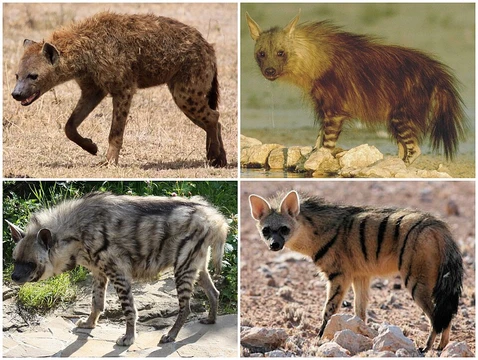
Today only four hyena species remain, each in its own genus, making Hyaenidae the fifth-smallest family in Carnivora. The aardwolf (Proteles cristata) is the sole descendant of the dog-like lineage, tracing an unbroken line back to Plioviverrops 15 million years ago; its survival is credited to an insectivorous diet and a unique ability to digest the terpene excretions of soldier termites, likely a repurposing of the powerful digestive system its ancestors used on carrion. The striped hyena (Hyaena hyaena) may descend from the Pliocene African form Hyaenictitherium namaquensis and likely spread into Eurasia only after spotted hyenas went extinct in Asia at the end of the Ice Age, having been widespread in France, Germany, Austria, Portugal, and Gibraltar during the Pleistocene. The spotted hyena (Crocuta crocuta) split from its striped and brown relatives 10 million years ago, with its direct ancestor being the Villafranchian Indian Crocuta sivalensis, and likely evolved social behaviors as pressure on carcasses intensified.
Frequently Asked Questions
Who is Wolf?
The wolf (Canis lupus), often called the grey or gray wolf, is the largest surviving wild member of the dog family, native to the wildlands of Eurasia and North America. It is recognized by its stocky frame, relatively short torso, and longer tail that set it apart from other Canis relatives.
What are Wolf's powers or role?
As a top-tier cooperative hunter, the wolf takes down large game through coordinated pack tactics organized around a bonded breeding pair and their offspring. This makes it the apex predator of the ecosystems it inhabits across its range.
Why is Wolf important?
Sitting at the top of food webs across its range, the wolf helps regulate prey populations and shape the structure of entire ecosystems. Removing or restoring wolf packs triggers cascading effects on vegetation, river channels, and other wildlife.
What sets Wolf apart from other Canis species?
Compared to coyotes, jackals, and dholes, the wolf has noticeably less pointed ears and muzzle, a shorter torso, and a longer tail. These physical traits, combined with its sheer size, make it the biggest wild canid still alive today.
More in Canids And Hyaenids 25-28
Elsewhere in the Canids And Hyaenids universe
Spotted an error? Know more?
This is a living reference — every entry is fact-audited, and reader corrections feed straight into our audit queue. Suggest an edit · See this site's audit record