Golden jackal
A wolf-like canid native to Eurasia, adaptable and widespread.

The golden jackal (Canis aureus), also called the common jackal, is a wolf-like canid native to Eurasia. It is listed as Least Concern on the IUCN Red List due to its widespread distribution and high density in areas with plenty of available food and optimum shelter. Despite its name, it is not closely related to the African black-backed jackal or the side-striped jackal, but is instead closer to wolves and coyotes.
- Scientific name
- Canis aureus
- Also known as
- Common jackal
- IUCN status
- Least Concern
- Native range
- Eurasia
- Number of subspecies
- 6
- Closest relatives
- Wolves and coyotes
Lore & Background
The golden jackal's coat varies from pale creamy yellow in summer to dark tawny beige in winter. It is smaller than the Arabian wolf, with shorter legs, a shorter tail, a more elongated torso, a less-prominent forehead, and a narrower, more pointed muzzle. It is abundant in valleys and beside rivers, canals, lakes, and seashores, but rare in foothills and low mountains. It is a social species whose basic unit consists of a breeding pair and any young offspring. It is very adaptable, exploiting food from fruit and insects to small ungulates, and attacks domestic fowl and mammals up to the size of water buffalo calves. Its competitors include the red fox, steppe wolf, jungle cat, Caucasian wildcat, raccoon, and Asiatic wildcat.
Reader's Guide
The golden jackal is significant as a highly adaptable canid that has expanded beyond its native grounds in Southeast Europe into Central Europe as far as France, and Northeast Europe into areas with few or no wolves. Its ancestor is believed to be the extinct Arno river dog from southern Europe 1.9 million years ago. The golden jackal is capable of producing fertile hybrids with both the gray wolf and the African wolf, and jackal–dog hybrids called Sulimov dogs are used for scent-detection at Sheremetyevo Airport near Moscow. Its legacy includes clarifying canid evolution, as genetic studies show it is not monophyletic with other jackals, and its African populations have been reclassified as a separate species, the African wolf.
Did You Know?
- The golden jackal is not closely related to the African black-backed jackal or the side-striped jackal, which are part of the genus Lupulella.
- Jackal–dog hybrids called Sulimov dogs are deployed by Aeroflot at Sheremetyevo Airport for scent-detection.
- The golden jackal's ancestor is believed to be the extinct Arno river dog that lived in southern Europe 1.9 million years ago.
Deep Roots: Origins and the Great Divergence
Hyenas trace their evolutionary story back to the dense jungles of Miocene Eurasia, roughly 22 million years ago, at a time when most of their feliform relatives still spent considerable time in the trees. The earliest identifiable hyena, Plioviverrops, was a slender, civet-like creature whose membership in the family Hyaenidae is confirmed by the architecture of its middle ear and the arrangement of its teeth. From this modest ancestor, the lineage stretched toward longer limbs and sharper jaws, a trajectory that mirrors what canids would later pursue on other continents. Over time, the family split into two fundamentally different body plans: lightly built, dog-like runners and heavily constructed bone-crushers. Despite their superficial resemblance to wolves and jackals—both groups are ground-dwelling, endurance-oriented hunters that seize prey with their teeth rather than claws—genetic evidence places hyenas far closer to cats and civets. Their grooming rituals, scent-marking, defecation patterns, mating displays, and parental care all align with other feliforms, revealing that the canid look is a product of convergent evolution rather than true kinship.
The Golden Age of Dog-like Hyenas
At their zenith around 15 million years ago, the dog-like hyena lineage boasted more than thirty identified species, a diversity that made them the most numerous carnivores in many Miocene ecosystems. In certain fossil deposits, the bones of Ictitherium and its relatives outnumber the remains of every other carnivore combined, painting a picture of a world where these nimble, wolfish hunters dominated the landscape. One species, Ictitherium viverrinum, closely resembled a modern jackal in build and proportion. The collapse of this radiation began five to seven million years ago, driven by a shift in climate and compounded by the arrival of true canids across the Bering land bridge into Eurasia. A single species, Chasmaporthetes ossifragus, managed to cross that same bridge into North America—the only hyena ever to do so—and survived for a period by evolving into a cheetah-like sprinter, sidestepping the endurance-running and bone-crushing niches already occupied by dogs. By 1.5 million years ago, nearly all dog-like hyenas had vanished. The sole survivor, the insectivorous aardwolf, escaped extinction by feeding on termites, a diet that placed it beyond the competitive reach of the incoming canids.
Bone Crushers and the Scavenger Throne
By ten to fourteen million years ago, the hyena family had cleanly divided into its two major branches, and the bone-crushing lineage was already asserting itself. Their rise paralleled the decline of the similarly built Percrocutidae family, and unlike their dog-like cousins, these robust scavengers weathered both the climatic upheavals and the canid invasion that erased the other branch. They never set foot in North America, where the Borophaginae subfamily had already claimed the large-carnivore niche. By five million years ago, bone-crushing hyenas had secured their position as the premier scavengers across Eurasia, feeding primarily on the carcasses of large herbivores brought down by sabre-toothed cats. The genus Pachycrocuta represented the apex of this strategy: a 110-kilogram mega-scavenger powerful enough to shatter the bones of elephants. In the early Middle Pleistocene, Pachycrocuta gave way to the smaller Crocuta and Hyena genera, a turnover that coincides with the broader faunal shifts of the Mid-Pleistocene transition, reshaping the scavenging landscape for millennia to come.
Four Survivors and a Dark Legacy
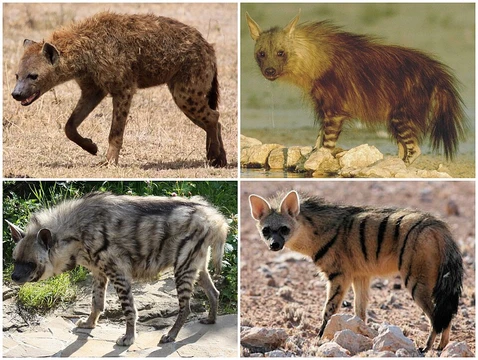
Today, the family Hyaenidae is represented by just four living species, each in its own genus: the striped hyena, the brown hyena, the spotted hyena, and the aardwolf. The striped hyena, whose African fossils stretch back to the Villafranchian, likely spread into Eurasia only after spotted hyenas vanished from Asia at the close of the Ice Age. During the Pleistocene it ranged across France, Germany, Austria, Portugal, and Gibraltar, where the European form was notably larger than modern populations, approaching the size of the brown hyena. The spotted hyena split from its striped and brown relatives ten million years ago, descending from the Villafranchian Indian species Crocuta sivalensis, and likely evolved its social group structure in response to intensifying competition over carcasses. Beyond their ecological roles, hyenas occupy a deeply ambivalent place in human culture. Across societies that share landscapes with them, they are frequently cast as objects of fear and contempt, credited in folklore with stealing livestock and children, disturbing the dead, and wielding influence over human spirits. In other traditions, their body parts are incorporated into traditional medicine and linked to witchcraft, cementing their reputation as creatures of the supernatural.
Frequently Asked Questions
What are Golden jackal's powers/role?
As a highly adaptable omnivore, the golden jackal handles a wide diet of small prey, carrion, and fruit, letting it thrive in habitats where less flexible predators struggle. This dietary versatility, combined with its tolerance for varied shelter types, is its main competitive edge across Eurasia.
How does Golden jackal's story end?
The golden jackal's arc is far from tragic—it currently sits at Least Concern on the IUCN Red List. Its broad distribution and ability to sustain high population densities wherever food and cover are adequate point to a stable, ongoing presence rather than any looming decline.
Why is Golden jackal important?
The golden jackal serves as a mid-level predator and scavenger that helps keep small-mammal populations in check and removes carrion from Eurasian landscapes. Its success in human-modified environments also makes it a useful barometer for how wildlife adapts to shifting land use.
Is Golden jackal related to African jackals?
Despite sharing the 'jackal' name, the golden jackal is not a close relative of the black-backed or side-striped jackals found in Africa. Genetically and morphologically, it clusters much nearer to wolves and coyotes within the genus Canis.
More in Canids And Hyaenids 1-24
Elsewhere in the Canids And Hyaenids universe
Spotted an error? Know more?
This is a living reference — every entry is fact-audited, and reader corrections feed straight into our audit queue. Suggest an edit · See this site's audit record