Grey wolf
Largest wild canid, apex predator of Eurasia and North America.

The grey wolf (Canis lupus), also known as the wolf, is a canine native to Eurasia and North America. It is the largest wild extant member of the family Canidae, distinguished by less pointed ears and muzzle, a shorter torso, and a longer tail. The wolf is an apex predator specialized for cooperative game hunting, traveling in nuclear families of a mated pair and their offspring.
- Scientific name
- Canis lupus
- Common names
- Grey wolf, gray wolf
- Family
- Canidae
- Native range
- Eurasia and North America
- Conservation status
- Least Concern (IUCN)
- Number of recognized subspecies
- More than thirty, including dog and dingo
Lore & Background
The wolf's fur is usually mottled white, brown, grey, and black, with arctic subspecies possibly nearly all white. It is closely related to smaller Canis species such as the coyote and golden jackal, with which it can produce fertile hybrids. Wolves are territorial, and fights over territory are a principal cause of mortality. They feed on large wild hooved mammals, smaller animals, livestock, carrion, and garbage. Single wolves or mated pairs often have higher hunting success than large packs. Pathogens and parasites, notably rabies, may infect wolves.
Reader's Guide
The grey wolf has a long history of interactions with humans. It has been despised and hunted in most pastoral communities due to attacks on livestock, while respected in some agrarian and hunter-gatherer societies. Although fear of wolves exists in many human societies, most recorded attacks on people are attributed to animals suffering from rabies. Wolf attacks on humans are rare because wolves are relatively few, live away from people, and have developed a fear of humans from experiences with hunters, farmers, ranchers, and shepherds. The wolf's evolutionary lineage includes descent from earlier species such as C. Genomic studies show modern wolves and dogs share a common ancestral wolf population, with divergence times varying across regions.
Did You Know?
- The English word 'wolf' stems from Old English 'wulf', derived from Proto-Germanic '*wulfaz' and Proto-Indo-European '*wĺ̥kʷos'.
- Linnaeus classified the domestic dog as Canis familiaris and the wolf as Canis lupus, considering them separate species due to the dog's upturning tail.
- More than thirty subspecies of Canis lupus have been recognized, including the dog and dingo.
- Wolves are most specialized for cooperative game hunting among all members of the genus Canis.
Deep Roots in the Miocene Jungle
Hyenas trace their evolutionary story back approximately twenty-two million years to the dense jungles of Miocene Eurasia, a time when most of their feliform relatives still spent much of their lives in the trees. The earliest identifiable members of the family, such as Plioviverrops, were slender, civet-like creatures that roamed the Eurasian landscape twenty to twenty-two million years ago. Paleontologists recognize these animals as true hyaenids not by their overall body shape but by the distinctive architecture of their middle ear bones and the arrangement of their teeth. From this modest civet-like starting point, the lineage gradually evolved longer limbs and more pointed jaws, a trajectory that mirrors the body plan canids independently developed in North America. This early adaptive radiation set the stage for the family's later split into two profoundly different ecological strategies, one of which would ultimately dominate the African and Eurasian savannas for millions of years.
The Wolfish Dynasty That Ruled the Miocene
At their zenith roughly fifteen million years ago, the dog-like hyenas represented one of the most diverse carnivore assemblages in Earth's history, with more than thirty distinct species identified from the fossil record. These were not the bulky bone-crushers people picture today; instead, they were agile, wolfish hunters built for speed and pursuit. One notable member, Ictitherium viverrinum, bore a striking resemblance to a modern jackal. In certain Miocene fossil deposits, the skeletal remains of Ictitherium and its dog-like relatives actually outnumber the bones of every other carnivore found at the same site, underscoring how dominant this lineage once was. Their reign ended between five and seven million years ago, when shifting climate and the arrival of true canids across the Bering land bridge proved fatal. A single exception, Chasmaporthetes ossifragus, crossed into North America and survived briefly by reinventing itself as a cheetah-like sprinter. The broader dog-like lineage was essentially extinct by 1.5 million years ago, leaving only the insect-eating aardwolf as a living remnant.
Mega-Scavengers and the Modern Four
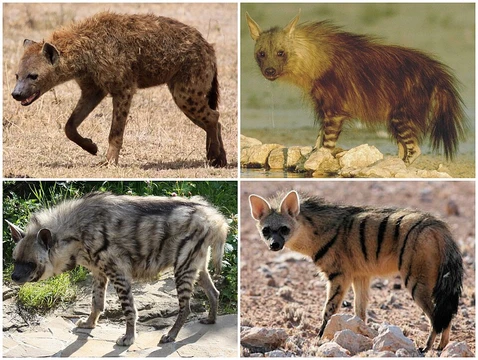
By ten to fourteen million years ago, the hyena family had cleanly divided into two ecological camps: the lightly built dog-like hunters and the robust, bone-crushing specialists. It was the latter group that weathered the climatic upheavals and competitive pressures that eliminated their dog-like cousins. These bone-crushers never ventured into North America, where the dog subfamily Borophaginae had already claimed that scavenging niche. Instead, they consolidated their dominance across Eurasia, and by five million years ago they were the premier scavengers on the continent, feeding primarily on the carcasses of large herbivores felled by sabre-toothed cats. One remarkable genus, Pachycrocuta, grew to roughly 110 kilograms and possessed jaws powerful enough to splinter the bones of elephants. In the early Middle Pleistocene, this giant was succeeded by the smaller Crocuta and Hyena genera, a shift that coincided with broader faunal turnover. Today, four species survive: the striped, brown, and spotted hyenas, plus the aardwolf, which alone preserves the ancient dog-like lineage.
A Feliform Soul in a Canid Body
Hyenas occupy a fascinating taxonomic paradox. Genetically, they sit closer to cats and civets than to any member of the dog family, yet millions of years of convergent evolution have sculpted them into animals that look and move remarkably like canids. They are ground-dwelling, long-distance runners that seize prey with their teeth rather than their claws, and their feet bear calloused pads and large, blunt, non-retractable nails perfectly suited for sprinting and making sharp turns. They devour food rapidly and may cache leftovers, habits that echo canine behavior. Yet strip away the running and hunting, and the underlying behavioral architecture is unmistakably feliform: their grooming rituals, scent-marking patterns, defecation habits, mating displays, and parental care all align with those of cats and civets. This duality has fueled a rich and often fearful cultural legacy. Across the human societies that share landscapes with hyenas, they are depicted as terrifying and contemptible creatures, accused of haunting spirits, desecrating graves, stealing livestock and children, and serving as instruments of witchcraft, with their body parts incorporated into traditional medicine.
Frequently Asked Questions
Who is Grey wolf?
The Grey wolf (Canis lupus) is the biggest living wild member of the dog family, ranging across Eurasia and North America. It stands out among canids with a comparatively blunt muzzle, a shorter torso, and a longer tail.
What are Grey wolf's powers/role?
It functions as a top-tier predator that hunts large prey in coordinated family units built around a bonded pair and their young. This cooperative pack strategy lets it bring down animals far larger than itself.
Why is Grey wolf important?
As an apex predator it keeps herbivore populations in check, which in turn shapes vegetation patterns and even river dynamics across whole ecosystems. Removing it from a landscape triggers cascading effects throughout the food web.
What's Grey wolf's origin/background?
It belongs to the genus Canis within the family Canidae and is native to the northern continents of Eurasia and North America. Over time it has diversified into numerous regional subspecies adapted to tundra, forest, and mountain habitats.
More in Canids And Hyaenids 1-24
Elsewhere in the Canids And Hyaenids universe
Spotted an error? Know more?
This is a living reference — every entry is fact-audited, and reader corrections feed straight into our audit queue. Suggest an edit · See this site's audit record