Frequently Asked Questions
The most-asked questions about canids and hyaenids.
What exactly are canids and hyaenids?
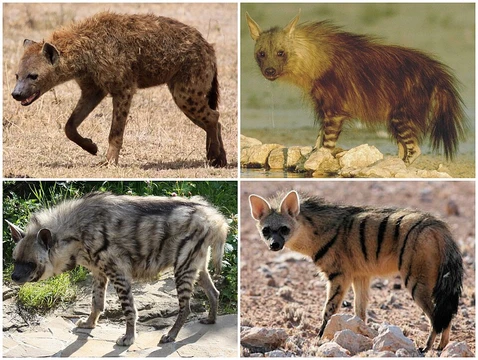
Canids are the dog-like members of the order Carnivora, encompassing wolves, coyotes, foxes, jackals, dholes, and dingoes. Hyaenids are the four extant hyena species—spotted, brown, striped, and aardwolf—found across Africa and the Middle East. Both families are obligate carnivores but occupy very different evolutionary lineages within the same order.
How many living species are in each family?
The family Canidae contains roughly 36 recognized species spread across 11 genera. Hyaenidae is far smaller, with only four extant species divided among three genera (Crocuta, Hyaena, and Parahyaena).
Are hyaenids closely related to canids?
No. Despite both being carnivorous mammals, canids belong to the suborder Caniformia while hyaenids sit in Feliformia, making them more distantly related to each other than either is to cats. Their similar diets and social lives are largely convergent adaptations rather than evidence of close kinship.
What is the size range across both families?
Among canids, the gray wolf tops out near 60 kg while the fennec fox weighs under one kilogram. In hyaenids, the spotted hyena can exceed 80 kg, and the aardwolf is the smallest at roughly 5–14 kg, so both families span a wide body-mass spectrum.
Which species is the most iconic in each family?
The gray wolf is the flagship canid, famous for its pack hunting and cultural symbolism across many human societies. The spotted hyena plays that role among hyaenids, being the largest, most numerous, and most studied member of the family.
How do their social structures compare?
Many canids live in cooperative packs led by a breeding pair, though foxes and some jackals are more solitary or form small family units. Hyaenids, particularly spotted hyenas, form large matrilineal clans where females dominate males in size and social rank, a reversal of the pattern seen in most canids.
Where do canids and hyaenids live geographically?
Canids are found on every continent except Antarctica, ranging from Arctic tundra to tropical forests. Hyaenids are restricted to sub-Saharan Africa, the Arabian Peninsula, and parts of the Middle East, with the aardwolf limited to southern and eastern African savannas.
Are any species in these families critically endangered?
The striped hyena is listed as Vulnerable and the dhole as Near Threatened, while the fennec fox and several jackal species face habitat pressure but remain of Least Concern. No canid or hyaenid currently sits at the Critically Endangered level, though localized populations of the dhole and striped hyena are in serious decline.
What is a common misconception about hyaenids?
Popular culture often portrays hyenas as mindless, cowardly scavengers, but the spotted hyena is actually a highly successful predator that kills the majority of its own prey. Their powerful jaws and digestive system are adapted for a carnivorous, not merely scavenging, lifestyle.
Where should a newcomer start learning about both families?
A good first step is reading a comparative field guide or a peer-reviewed overview of Carnivora phylogeny to see how the two families fit into the broader order. From there, focusing on one flagship species per family—say the gray wolf and the spotted hyena—gives concrete behavioral and ecological context before branching out to rarer members like the dhole or aardwolf.